
Gold Immersion Chemical Comparison
Taekwang, SDS, W.S, and JinChan: Solution strength, gold recovery, and chemical costs in gold processing plants.
1. The Key Question for Miners: Which Chemicals Provide the Best Profits?
For many years, cyanide was the primary chemical used to extract gold from gold ore. Nearly all gold processing plants are accustomed to using the cyanide soaking process, and this method has been used worldwide for decades.
However, in recent years, many miners have begun to take a more serious look at alternative chemicals to cyanide. The reasons aren't just safety concerns or government regulations. In many mining operations, the biggest issue is actually the cost and volatile chemical prices.
Cyanide prices can be very expensive and fluctuate frequently. When prices rise, gold processing costs also rise. For factories processing large quantities of gold, the chemical can quickly become one of the largest operational costs.
Because of this many operators are starting to ask:
Is there any other chemical that can dissolve gold well but at a lower cost?
Currently, some of the products that are frequently discussed in the industry include:
-
Taekwang
-
Sandioss (SDS)
-
W.S
-
Jin Chan
Each of these products claims to effectively dissolve gold. But for miners, the real decision isn't based solely on sales claims. The most important question is actually much simpler and more practical.
Want to know how much you could save by replacing cyanide with Sandioss?
Use ksavings calculator Cyanide vs. Sandioss costs to estimate potential savings for your mining operations. If you're interested in implementing this process, Promining also provides training on Sandioss for mine operators.
Miners and mill operators typically want to know three main things:
1. How much gold can be taken?
The primary goal of gold immersion chemistry is to recover as much gold as possible from the gold ore. Small differences in recovery can have a significant impact on production. If a plant processes hundreds of tons of gold ore daily, adding even 1 gram of gold per ton can significantly increase production yield.
2. How much chemical should be used?
Each type of chemical may require different amounts to achieve a solution strong enough to dissolve gold. A product may appear strong, but in practice, it may require more chemicals.
3. How much is the total chemical cost?
In many mining operations, chemical costs are as important as gold recovery. A chemical may recover slightly more gold, but it can still be less profitable if it costs significantly more to use.
For these reasons, miners typically evaluate gold chemistry based on overall profitability, not just laboratory test results.
A chemical that can provide:
-
strong gold dissolving ability
-
stable recovery results
-
reasonable use of chemicals
-
and lower costs
is often the best choice for gold processing in the field.
To better understand the comparisons between several commonly used gold soak chemicals, a simple test was conducted using the same amount of each product under the same conditions. The goal was to determine the strength of the solution produced by the same amount of chemicals and then translate those results into their impact on gold yield and processing costs.
2. Quick Comparison: What Miners Want to Know Most
Before looking at more detailed test data, miners usually want to see a quick comparison that gets straight to the point.
The most important questions are usually:
-
Which chemical dissolves gold most effectively?
-
How much gold can actually be recovered?
-
How do the different chemicals compare when used in a gold processing plant?
Based on comparative data and field experience, these four types of chemicals can be summarized as follows.
Comparison of Strength and Recovery

This table shows the general performance pattern of each product.
Taekwang produces the strongest solution, so in some cases it can provide slightly higher recovery.
SDS also produces a strong solution, and its estimated recovery is very close to Taekwang.
W.S produces a medium-strength solution. Gold can still be recovered, but more is usually left behind than with stronger chemicals.
Jin Chan produces the weakest solution of the four products, so gold recovery is usually lower under the same conditions.
Why This Distinction Matters
In gold processing, seemingly small differences in recovery can be very large in real operations.
As an example:
If a factory processes 100 tons of gold ore per day, at a grade of 10 grams of gold per ton, that means the factory is putting about 1 kilogram of gold into the process every day.
A difference in recovery of just 2% could mean around 20 grams of gold per day.
If calculated in weeks or months, this difference can be a very large amount of gold.
Therefore, operators usually choose chemicals that can provide consistently high recovery, while still keeping operating costs under control.
Important Things Miners Need to Pay Attention to
From the comparison above, one thing is quite clear.
Recovery SDS is very close to Taekwang, although Taekwang produces the strongest solution.
On the other hand, SDS showed a much stronger performance than W.S and JinChan.
This puts SDS in a very interesting position:
-
stronger than some competing chemicals
-
recovery is approaching the strongest product
-
potentially more economical depending on chemical prices
3. The Most Important Difference: Chemical Costs
While recovery and solution strength are important, many miners will say the same thing:
The actual decision is often determined by chemical costs.
A chemical may be able to extract a little more gold, but if the cost of using it is much higher, the profitability of the mining operation may actually decrease.
Therefore operators usually look at two things at once:
-
how much chemical to use
-
how much does the chemical cost?
This is where the comparison between Taekwang and SDS becomes very interesting.
Chemical Use
In most operations, SDS is used about three times more than Taekwang.
This is important to understand clearly.

This means that to replace one drum of Taekwang, it usually takes about 150 kg of SDS.
At first glance, this may seem like a drawback. However, when you look at the total chemical costs, the results are quite different.
Cost Comparison
Current market prices show a very clear difference.

Even though SDS requires three times more by weight, the total chemical cost remains much lower.
This means that replacing one Taekwang drum with an SDS can reduce chemical costs around:
Rp22,600,000 for the equivalent amount of usage.
Why This Is Important for Processing Plants
For even minor operations, this cost difference is already quite large.
But for a plant that uses several drums of chemicals each week, these savings can add up to significant savings over time.
Reducing chemical costs by tens of millions of rupiah per production cycle can have a major impact on the overall profitability of an operation.
That's why many operators not only look at the strength of the solution, but also assess the balance between recovery and chemical costs.
4. What This Means for Gold Processing Plants
The above comparisons help understand chemical strengths, but miners usually want to know what the numbers mean in real plant operations.
To explain this, we can look at a simple example of a small-scale gold processing plant.
Suppose the following conditions:
-
Gold content: 10 grams per ton of gold rock
-
Factory capacity: 100 tons of gold stone per day
This means the plant puts about 1,000 grams (1 kg) of gold into the process every day.
Depending on the chemicals used to soak the gold, the amount of gold recovered will vary.
Gold Production Estimates
Based on the estimated recovery from the previous comparison, daily production could look like this.

This table shows that the difference between Taekwang and SDS is actually quite small in terms of recovery.
The difference is only about: 20 grams of gold per day.
In contrast, the difference between SDS and weaker chemicals such as W.S or JinChan can be much greater.
Monthly Production Comparison
When viewed over a longer period of time, the differences become more apparent.
If the factory operates 30 days a month, then the estimated gold production is:

Compared to Jin Chan, using SDS can yield approximately:
6 kg more gold every month.
Compared to W.S., SDS can yield approximately:
3 kg more gold every month.
Practical Conclusions for Miners
For many miners, the important thing to see from this comparison is:
The difference in recovery between Taekwang and SDS is relatively small, while the difference between SDS and weaker chemicals can be much greater.
This puts SDS in a fairly strong position for many gold processing operations:
-
recovery approaches the most powerful chemistry
-
much better than some of the weaker alternatives
-
may be more cost-effective depending on the price of the chemicals used
5. How to Use in the Field: Switch from Taekwang (Liquid) to SDS (Powder)
For miners already using Taekwang, the most important question is usually not just about performance, but also what changes in day-to-day operations if they switch to SDS.
The main difference between these two products is their physical form.
-
Taekwang is sold in liquid form.
-
SDS (Sandioss) is sold in solid powder form.
These differences affect how the gold is stored, transported, and prepared for use, but the process of soaking the gold in the tank remains essentially the same.
Chemical Forms and Storage
Taekwang typically comes in liquid drums, usually about 50 kg per drum. These drums must be stored in a safe location for liquid chemicals.
SDS is sold in powder bags, which can be stored in a dry place like other solid chemical storage materials commonly used in mines.
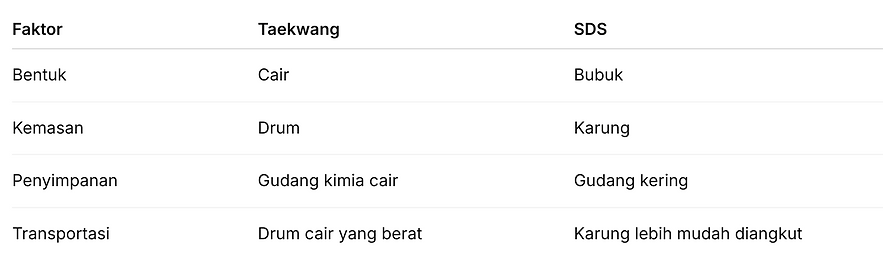
Because SDS comes in powder form, transportation and storage are often easier, especially for remote or hard-to-reach mining sites.
In addition, drums of liquid chemicals often attract the attention of authorities or inspectors, whereas bags of powder are generally considered safer and less conspicuous.
How to Prepare the Chemicals
Another difference is how the chemicals are introduced into the gold leaching process.
With Taekwang, since the chemical is already in liquid form, it can usually be pumped directly into the leaching tank.
With SDS, the powder must first be dissolved in water before being added to the tank.
The preparation process is usually as follows:
-
Fill the mixing tank with water
-
Add the required amount of SDS
-
Stir until the powder dissolves
-
Pump the SDS solution into the immersion tank
Once the SDS has dissolved, the solution can be used with the same system as other liquid chemicals.
Amount of Chemical Used
Another difference is the amount of chemical used.
In many operations, SDS is used about three times more than Taekwang.

This means that to replace one Taekwang drum, it usually takes about 150 kg of SDS.
Even though the amount of SDS used is greater, the total chemical cost can still be much cheaper because the price of SDS per kilogram is much lower.
Practical Conclusions for Operators
For factories currently using Taekwang, switching to SDS essentially requires only three major adjustments:
-
handling powder, not liquid
-
dissolving the powder in water before adding it to the tank
-
using a larger amount of chemical by weight
However, once the SDS has been dissolved, the solution can be used with the same soaking tanks and recovery systems as those already in use at many gold processing plants.
Because the process remains nearly the same, many operators can try SDS without having to change major equipment in their plants.
Conversion Training at Mine Sites
Switch from cyanide to Sandioss right in your mine
Price
35 million IDR (≈ price of 1 drum of cyanide)
Including
• On-site operator training
• 8 working days
• Demonstration of the leaching process
• Dosage and mixing guide
• Your team learns to execute processes
Condition
Minimum 350 kg Sandioss
Laboratory Demonstration Training
Study the Sandioss process before implementing it in the mine
Price
32 million IDR
Including
• Gold leaching demonstration
• 4-5 working days
• Batch processing of 30–50 kg of ore
• Preparation and dosage of Sandioss
• Process control basics
Condition
Purchase of 5 sacks of Sandioss
6. Production Data: Comparison of Solution Strengths in Real-World Operations
This comparison of chemicals is not based on laboratory experiments.
These figures come from real production data collected while the plant was in operation.
This means the results reflect actual processing conditions, including the mixture of water and gold ore in the tanks, the agitation process, and how the chemicals react with the gold ore.
For miners and mill operators, this type of data is usually more useful than laboratory tests, because it shows how the chemistry works in the actual gold processing process.
Measurement Method
During operation, the strength of the solution in the tank is measured using AgNO₃ titration.
This method is used to measure how strong the solution's ability to dissolve gold after chemicals are introduced.
The higher the number, the stronger the solution is at dissolving gold.
For operators, the way to read it is quite simple:
A stronger solution provides better conditions for dissolving gold in the leaching tank.
Results Recorded in Production
The following values were recorded using the same measurement method.
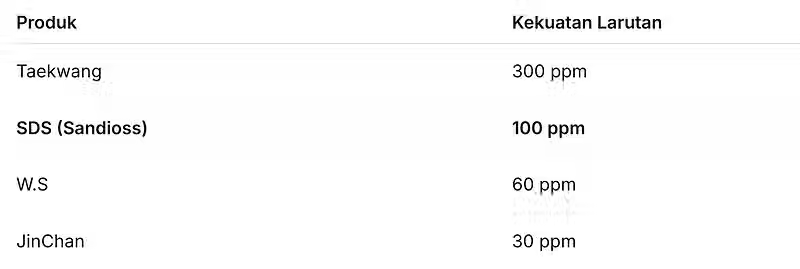
These numbers show how strong the solution produced by each chemical is when used in operations.
How to Read This Production Data
From the recorded data, it can be seen that:
-
Taekwang produces the strongest solution
-
SDS produces a strong solution
-
W.S produces a moderately strong solution
-
JinChan produces the weakest solution
In terms of strength:
-
SDS is more than three times stronger than JinChan
-
SDS is much stronger than W.S
-
Taekwang remains the strongest in terms of solution strength
What This Means for Operators
Production data like this helps explain why different chemistries can yield different performance results at gold processing plants. A stronger solution typically means the chemistry dissolves gold more quickly and effectively, which can help improve recovery if process conditions are right.
However, as explained earlier, miners typically evaluate chemicals based on a balance between solution strength, gold recovery, and total chemical costs. For this reason, many operators view SDS as an attractive option: its strength is sufficiently high, yet its chemical costs are significantly lower than those of some alternatives.
7. Final Comparison for Miners
After reviewing production data, estimated recovery rates, chemical consumption, and field application methods, the comparison between the various chemicals becomes clearer.
Miners typically evaluate gold leaching chemicals based on four key factors:
-
The solution’s ability to dissolve gold
-
Achievable gold recovery
-
Chemical costs
-
Ease of use in the field
The following table summarizes how these four products compare based on these factors.

This comparison shows several important things.
First, Taekwang produces the most powerful solutions, which under certain conditions can provide very high recoveries.
Second, SDS produces a strong solution with a recovery very close to Taekwang, and its performance is clearly better than W.S and JinChan.
Third, When chemical costs are taken into account, SDS becomes very attractive because the total chemical costs can be much lower, even though the quantities used are higher.
Important Things for Operators
When viewed from a field operations perspective, this comparison can be summarized as follows:
-
Taekwang: the most powerful solution, but also the most expensive chemical cost
-
SDS: strong performance at much lower chemical costs
-
W.S: moderate performance
-
JinChan: the weakest solution of the four products
For many gold processing plants, the final decision is usually not based solely on chemical strength, but on overall economic results.
The Balance to Choose
The comparison between Taekwang and SDS shows this clearly.
In some cases, Taekwang may yield slightly higher recoveries. However, SDS can provide very similar performance at a much lower chemical cost.
For operations processing large quantities of gold ore, this difference in chemical costs can translate into significant savings over the long term.

8. Final Conclusion
For gold processing plants, the goal is always the same:
To extract as much gold as possible while keeping operating costs under control.
When miners compare gold leaching chemicals, they typically look at three main factors:
-
how much gold can be recovered
-
how much chemical to use
-
what the total cost of the chemicals is
The comparison described in this article shows fairly clear differences between the four products.
Taekwang produces the strongest solution and, under many conditions, can yield very high recovery rates. However, in this comparison, Taekwang is also the most expensive chemical.
SDS (Sandioss) delivers strong gold leaching performance with a recovery rate very close to that of Taekwang, and at the same time is clearly superior to W.S. and JinChan. In addition, SDS can also provide significant chemical cost savings, even though it requires a higher dosage.
W.S delivers moderate performance, while JinChan produces the weakest solution among the products compared.
For many plant operators, the key takeaway is that chemical strength alone does not determine the best choice. What matters most is the balance between gold recovery and operating costs.
Since SDS offers:
-
strong gold dissolving ability
-
recovery rates approaching those of the strongest chemical
-
significantly lower chemical costs
SDS can be a highly practical and economical choice for many gold processing operations.
For plants currently using more expensive chemicals, testing SDS under actual operating conditions could open up opportunities to maintain high gold recovery rates while reducing total chemical costs.
This article refers to scientific studies on the use of Sandioss as an easy-to-use, environmentally friendly leaching reagent for gold extraction from refractory gold ores (reptiles containing fine gold). For a more in-depth understanding of the methodology and application, readers are encouraged to review the full scientific publication.